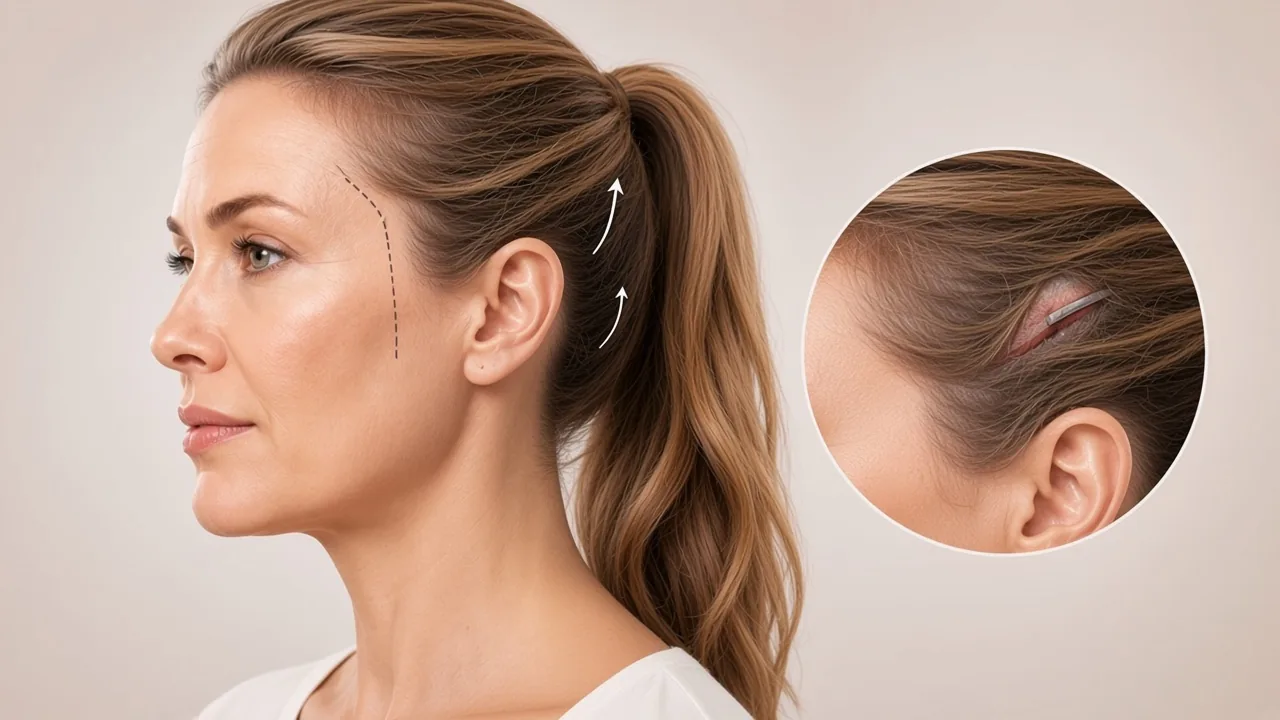
What a “Ponytail Facelift” Actually Is
Marketing name, not a surgical class. “Ponytail facelift” is not a distinct operation in the way deep plane or SMAS are. ASPS does not list it as a procedure type. In the marketplace the same words cover several limited-incision and endoscopic lifts. In one peer-reviewed series the authors used the name for a specific endoscopic deep-plane method. Those two uses are not the same thing. A patient cannot infer the plane, the neck work, or the scar from the brand alone.
Where the Name Comes From
The image is simple. When hair is pulled up into a high ponytail, the temples rise, the midface looks tighter, and the jawline can look cleaner for a moment. Surgeons who hide cuts in the hair and lift on a more vertical vector borrowed that picture. Kao and Duscher, writing in Aesthetic Surgery Journal in 2024, said they chose “ponytail lift” because the vector “simulates the youthful appearance of having the hair pulled up in a high ponytail.”1
That paper is the main whitelist source that uses the exact name. It describes an endoscopic deep-plane operation with incisions in the temple, the groove behind the ear, and the posterior scalp. The authors split the work into types by age and neck skin. That is one defined use. It is not how every clinic uses the phrase.
Outside that series, “ponytail” is advertising copy. A consult that only says “we do the ponytail” has not yet named a technique.
Which Established Techniques It Usually Refers To
Most of the time the name is mapped onto work that already has older, more precise labels.
High-SMAS. The SMAS is the fibrous-muscular sheet under the skin of the face. A high-SMAS flap is planned along the upper border of the zygomatic arch so the jawline, cheek, and midface can move as one unit — a named method, not a slogan.3 When a surgeon says “ponytail” and then describes a high flap and a temporal cut, they are usually talking about this family of SMAS facelift operations.
Temporal lift. The work sits at the temple and lateral brow. Incisions hide in the hair. The target is the outer brow and the upper third, not a heavy neck or deep fold beside the mouth.
Endoscopic elements. A camera and short scalp ports can limit the length of the skin cut. The 2024 series that coined ponytail lift and ponytail facelift for the literature used endoscopy plus a deep-plane release.1 Endoscopic access does not, by itself, tell you how deep the surgeon works.
Deep-plane rhytidectomy itself is an established 1990 technique: a sub-SMAS flap that carries skin, cheek fat, and platysma together.2 If a ponytail-labelled case is truly that operation, the name is packaging. If it is a short temporal lift, the name is stretching. Only the operative plan settles which one you are buying.
Why Surgeons Use the Name
The name sells a package that is easy to picture: a shorter operation, a scar you cannot see in a photograph, and a younger patient who does not want to look “done.” Those three things are marketable. They are not dishonest on their own. A limited incision and a hidden scar can be the right plan for the right face.
The problem starts when the brand outruns the anatomy. A 38-year-old with early cheek flattening and a tight neck is a different case from a 58-year-old with jowls and a platysma band. Both may be offered a “ponytail.” Only one of those offers is likely to match what the word implied in the ad. The honest version of the pitch is: we will hide the cut in the hair and lift on a vertical vector, using this named technique, and we will or will not treat the neck.
How It Differs From Named Techniques
Treat “ponytail” as a label in the first column, not as a fourth anatomy. The rows below use the marketplace meaning: a limited, hairline-hidden lift. When a surgeon instead means the 2024 endoscopic deep-plane series, several cells move closer to the deep-plane column. That is why the name is a poor substitute for a technique list. For a fuller side-by-side, use the facelift types comparison.
| Feature | Ponytail (typical use) | Deep plane | SMAS | Mini |
|---|---|---|---|---|
| Incision | Temple / scalp hair; sometimes behind the ear | Temple, around the ear, into the hair; neck cut if needed | Around the ear, into the hair; neck cut common | Shorter cut in front of the ear / sideburn |
| Layer lifted | Often high-SMAS or temporal; sometimes endoscopic deep plane | Below SMAS, ligaments released, midface moved as one unit | On or within the SMAS (plication or SMASectomy) | Superficial SMAS plication, limited release |
| Typical age | 30s–40s in ads; older if neck skin is added | Mid-40s to 70s with real descent | 40s–60s with moderate jowls and neck | 40s–early 60s, early jawline change |
| How long it lasts | Follows the method underneath; limited lifts last a shorter span | Often the longest of the surgical options | Longer than mini; shorter than many deep-plane series | Shortest of the surgical options |
The mini column is the mini facelift as used on this site: a shorter, lower-face operation, not a synonym for ponytail.
Who It Suits
Typical Candidate Profile
The usual candidate in marketing — and in the younger types of the 2024 series — is someone in their 30s or 40s.1 Soft-tissue descent is starting in the midface or at the tail of the brow. The jawline may be slightly soft. The neck is still relatively tight. Skin still recoils. The person wants a change that does not read as “I had a facelift” in a side photograph, which is why a hairline cut is attractive.
That profile overlaps a mini facelift more than a full deep-plane case. The difference is emphasis. Mini work is built around the lower face and early jowl. Ponytail copy is built around the temple, the vertical vector, and the hidden scar. A consult should still map the actual descent, not the ad photo.
ASPS candidacy language for facelift in general is conservative: a healthy adult, a nonsmoker or someone willing to stop, and realistic goals. It does not publish an age cutoff for a temporal or high-SMAS lift. Age in this article is a pattern, not a rule.
Who It Does Not Suit
A heavy, lax neck is the clearest mismatch for a limited hairline lift. Skin that hangs under the chin, visible platysma bands, or a jawline that has lost its corner will not be corrected by a temple vector alone. Those faces usually need a technique that treats the neck and the deep cheek — most often a deep plane facelift. Neck lift is a separate operation and is not opened as its own page here; the point for this article is simpler: if the neck is the problem, a ponytail label is the wrong promise.
Advanced age is not an automatic no. Poor elasticity, large volume loss, and deep folds beside the mouth are. A short scar cannot rebuild a face that has dropped through several layers. Offering the brand anyway sets up an under-corrected result or a second operation.
What the Surgery Involves
Incision Placement and Scarring
MedlinePlus describes a standard facelift cut as starting above the hairline at the temples, passing around the ear, and ending in the lower scalp. Most of that scar is meant to sit in hair or in a natural crease.6 A ponytail-labelled case tries to keep even more of the cut inside hair — temple, posterior scalp, sometimes the groove behind the ear — and to avoid a long preauricular line when the neck is not being excised.1
Hidden is not invisible. Scalp skin still heals as a scar. Hair follicles along the line can go into shock or be destroyed. ASPS lists temporary or permanent hair loss at the incisions among facelift risks.5 In the 2024 series, transient alopecia at the incision occurred in 0.33% of 600 cases and settled over a few months.1 That is one team’s rate, not a guarantee. People who already thin at the temples should ask, in plain words, where the scar will sit if the hairline recedes later.
Anaesthesia
Facelift can be done under conscious sedation or general anaesthesia.6 The 2024 ponytail series used monitored anaesthesia care with propofol and avoided intubation.1 That is one practice, not a society rule. A longer deep-plane case, a combined neck excision, or a patient with sleep apnea may be safer asleep. The choice belongs to the surgeon and the anaesthesia team, not to the brand name. For a patient-level comparison of the two main options, see twilight sedation versus general anaesthesia.
Operating Time
A limited temporal or high-SMAS lift can be shorter than a full deep-plane rhytidectomy. An endoscopic deep-plane case with neck-skin excision is not a short procedure, even if the scar is hidden. Ask for a time range for the exact plan: which zones, whether the neck is opened, whether eyelids or fat grafting are added. “Quick ponytail” is a slogan, not a schedule.
What It Costs
There is no official “ponytail facelift” price, because there is no official procedure class. The useful number from ASPS is the average US surgeon fee for a facelift (rhytidectomy): $11,395. That figure excludes anaesthesia and the facility.4 Figures below are in US dollars, current as of September 2026.
| Line item | United States (typical) | Turkey (typical) |
|---|---|---|
| Surgeon fee | ASPS average $11,395 for facelift; limited lifts often quoted lower, full deep-plane higher | Usually bundled; standalone surgeon fees are less often published |
| Facility | Separate hospital or accredited-office fee | Often inside an all-inclusive package |
| Anaesthesia | Separate; sedation and general are billed differently | Often inside the package |
| Patient total | Commonly well above the surgeon fee once facility and anaesthesia are added | $4,000–$12,000 for the closest comparable SMAS or deep-plane package; request an itemized quote |
If the name is used for a limited temporal or high-SMAS lift, the quote should sit below a full deep-plane package. If it is used for an endoscopic deep-plane operation with neck work, it should not. This page is not a cost guide. For ranges by country and technique, use the facelift cost hub.
Recovery
MedlinePlus puts most swelling and bruising in a 10–14 day window, with the face looking closer to normal at four to six weeks. Mild swelling can last longer.6 A limited hairline lift may recover faster than a full deep-plane dissection. An endoscopic deep-plane case will not. Plan time off around the method, not the brand.
Hairline cuts add a practical detail: you may need to keep the scalp clean, avoid tight ponytails on the incision, and wait for shed hairs to return if a strip of thinning appears. That is still facelift recovery, not a lunch-hour errand. The week-by-week picture lives on the facelift recovery timeline.
Risks and What Can Go Wrong
ASPS lists bleeding, infection, poor healing, unfavorable scars, facial-nerve injury with weakness, anesthesia events, and hair loss at the incisions.5 MedlinePlus names hematoma that may need drainage and facial-nerve weakness that is usually temporary.6 In the 2024 series of 600 cases: hematoma 0.33%, transient frontal-branch weakness 4.88% (resolved in 6–12 weeks), no permanent nerve injury in that cohort, and transient incision alopecia 0.33%.1 Those rates belong to one team and one method. They do not transfer to every clinic that borrowed the name.
What “Hidden Scar” Claims Leave Out
A scar in hair is still a scar. It can widen, thicken, or show if the hair is worn up, wet, or thinner than it was at surgery. Follicles can be cut. A later hair transplant along a bad scar is extra surgery, not a footnote. “No visible scar” in a marketing photo usually means “no scar in front of the ear in this lighting,” not “no incision.” Ask to see healed scalp scars at six months, not only three-quarter face shots at three weeks.
Questions to Ask Before Booking
- Which named technique will you use — high-SMAS, temporal lift, endoscopic deep plane, or something else? If the answer is only “ponytail,” the plan is not yet a plan.
- Which layer will you lift, and will you release retaining ligaments? Depth decides whether midface folds actually move.
- Will you treat my neck, and if not, why is a limited lift enough? Write down the answer. It is the most common mismatch.
- Where will every incision sit, and what happens to the scar if my hair thins? Ask about alopecia at the cut, not only about the hairline photo.
- What anaesthesia do you use for this exact operation, and who administers it? Sedation and general are both used. The setting matters more than the slogan.
- What does the quote include — surgeon, facility, anaesthesia, revision policy — in US dollars? Compare itemized numbers, not package adjectives.
Frequently Asked Questions
-
The name is real marketing language, not a separate operation on society procedure lists. One peer-reviewed series defines it as an endoscopic deep-plane lift with hidden scalp incisions. Many clinics use the same words for high-SMAS or temporal lifts. Ask which established technique will actually be performed.
-
There is no single ponytail fee. ASPS reports an average US facelift surgeon fee of $11,395 before facility and anesthesia. The closest Turkey comparisons are SMAS or deep-plane packages, generally $4,000–$12,000 on this site's 2026 cost table. The real price follows the technique underneath the label. Figures are in US dollars, current as of September 2026.
-
A named deep plane facelift releases retaining ligaments and repositions midface, jowls, and usually the neck as one unit. A ponytail-labelled operation may be that surgery done through hidden scalp cuts, or it may be a smaller temporal or high-SMAS lift that does not treat the neck. The name alone does not tell you the depth or the zones.
-
Yes. Hidden hairline or scalp incisions still heal as scars. Hair can thin along the cut, sometimes permanently. ASPS lists temporary or permanent hair loss at facelift incisions as a known risk. A “scarless” claim usually means the scar is harder to see in hair, not that no incision was made.
-
Clinics usually pitch it to people in their 30s and 40s with mild midface or brow descent and good skin elasticity. The only indexed series that uses the name also describes older patients when neck skin is excised. Age is a clue, not a rule. Neck laxity and tissue quality matter more than the birthday.
-
Longevity follows the technique underneath the name, not the name itself. A limited temporal or short-scar lift often lasts a shorter span than a full deep-plane or high-SMAS operation. Aging continues after any lift. Ask how long the surgeon’s own patients keep the result for the specific method being planned.